
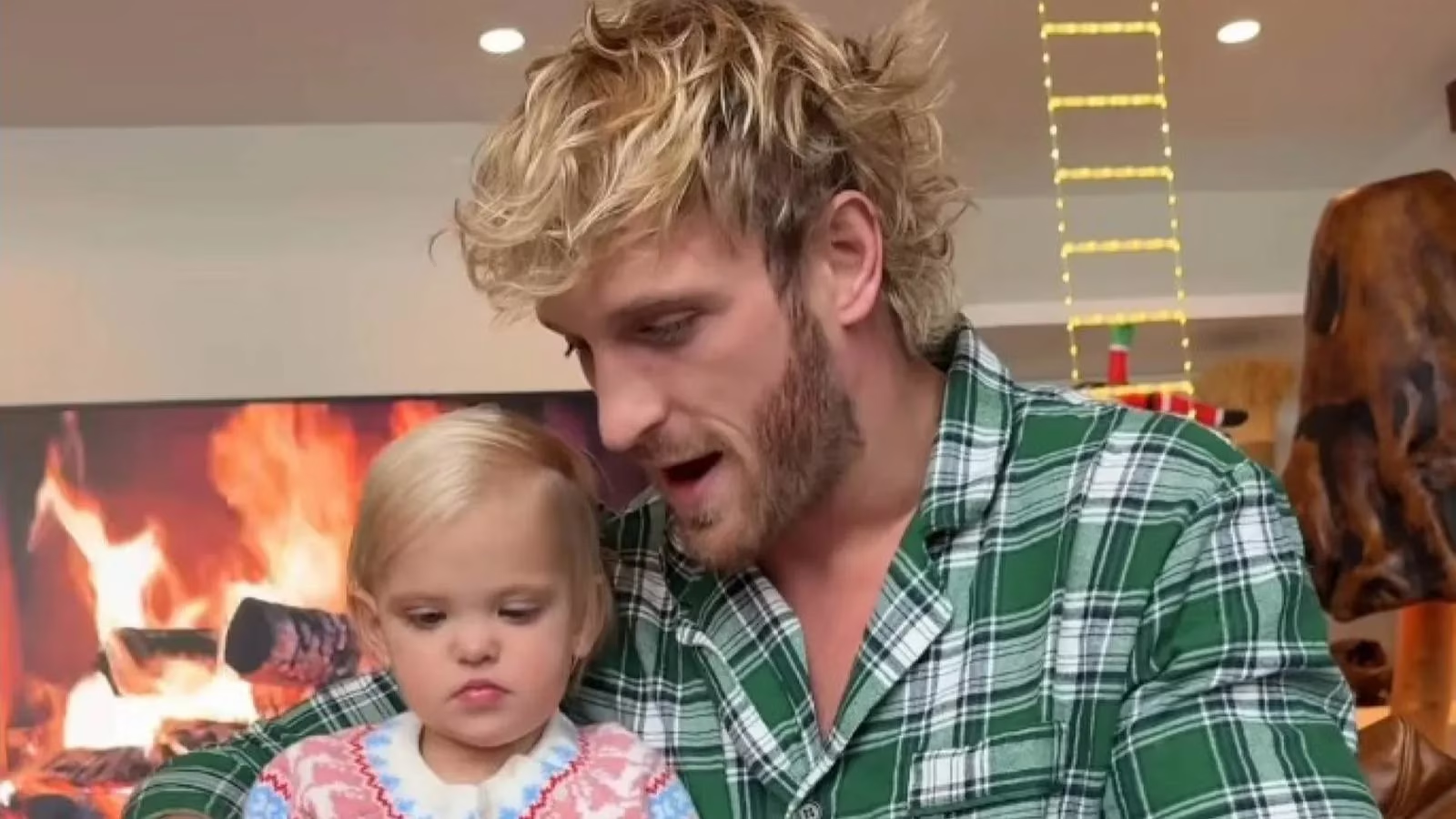
As a professional gamer and lifelong follower of the Pokemon Trading Card Game scene, I'm constantly fascinated by the intersection of high-stakes collecting, personal passion, and market dynamics. Just this past Christmas, WWE superstar Logan Paul provided a perfect case study, gifting his one-year-old daughter, Esme, a PSA 10 graded Shining Magikarp card valued at approximately $9,000. The video of the exchange, shared on his social media, wasn't just a heartwarming holiday moment; it was a snapshot of the modern TCG economy, where childhood nostalgia meets serious investment. For Paul, this wasn't an arbitrary choice. He explained the gift was inspired by Esme herself choosing Magikarp as her "Starter Pokemon," a detail that connects the card's immense monetary value back to the pure, personal joy at the franchise's core.
The Shining Magikarp card itself is a piece of Pokemon history. It originates from the Neo Revelation set, first released in English in September 2001, which is based on the Pokemon Gold and Silver games. This era introduced Shiny Pokemon to the world, and Magikarp's golden-scaled form quickly became an icon. In the TCG, Shining Magikarp and its evolution, Shining Gyarados, were the coveted "secret rares" of that expansion. Holding a PSA 10 gem mint copy, like the one Paul gifted, is like holding a preserved fragment of that early-2000s magic. It's a Basic Pokemon card with just 30 HP, a humble beginning that perfectly mirrors Magikarp's in-game journey from a seemingly useless 'Fish Pokemon' into the terrifying powerhouse, Gyarados.
Paul's move is consistent with his well-documented strategy of treating rare Pokemon cards as alternative assets. He famously spent $5.3 million in 2022 on the ultra-rare Illustrator Pikachu card and has announced plans to auction it in February 2026. The gaming and collecting community is watching closely to see if this investment will pay off. He's been vocal about his belief in the TCG's high return on investment, but his track record isn't flawless. In late 2025, he entered a $34,700 bid for a rare Kabuto card in a charity auction on eBay, only to be outbid by another collector who won with a staggering $51,100. While he didn't win, his participation helped drive significant attention and funds to St. Jude Children's Research Hospital, showing how these high-profile collectors can influence the market for charitable causes as well.
Looking at the broader 2026 landscape, the Pokemon TCG market shows no signs of cooling down. The frenzy around sealed products and chase cards has created an environment where scalpers are a constant threat. Retailers have been forced to adapt with purchase limits and exclusive early access tied to subscriptions like Walmart+. GameStop took one of the most aggressive stances, warning in a November 2025 social media post that it would ban individuals caught weighing packs in stores to identify valuable cards—a practice that undermines the fair chance for all fans. This ongoing battle between genuine collectors and profiteers is a defining tension in the hobby today.
-
Key Market Forces in 2026:
-
Anniversary Hype: The Pokemon franchise's 30th anniversary is fueling special sets and collaborations, keeping demand sky-high.
-
Celebrity Influence: Collectors like Logan Paul bring mainstream attention, affecting prices and interest levels.
-
Retailer Countermeasures: Stores are implementing anti-scalping tactics, changing how products reach consumers.
-
Charity Auctions: High-value cards are increasingly funneled into charitable fundraising, blending collecting with philanthropy.
This year is particularly significant as it marks Pokemon's 30th anniversary. We're already seeing plans for massive collaborations, including a potential partnership between the Pokemon TCG and McDonald's to distribute promo cards and packs through Happy Meals. While exciting for fans, this immediately raises questions about accessibility. Will McDonald's implement purchase limits to prevent scalpers from buying out entire stocks of Happy Meals just for the cards? The fast-food model presents a new frontier for the same old problems. The value of these promos could skyrocket if they become hard to obtain, continuing the cycle of scarcity and desire.
For someone like me, who plays games at the highest level, the parallel is clear. Just as in competitive gaming, success in TCG collecting in 2026 requires strategy, timing, and deep knowledge. It's not just about buying a cool card; it's about understanding its place in the game's history, its rarity trajectory, and the broader market forces at play. A card like Shining Magikarp is powerful not because of its in-game attack power—it has none—but because of its story, its scarcity, and the golden sheen of nostalgia it carries. Whether it's a $9,000 gift for a toddler or a multi-million dollar Pikachu awaiting auction, these pieces of cardboard are now firmly entrenched in the world of high-value collectibles, a trend that the 30th anniversary year will only amplify.