
It’s quiet now in the showcase, but the little yellow mouse wearing a grey felt hat has never been louder on the secondary market. Nearly three years after its chaotic debut at the Van Gogh Museum in Amsterdam, the Pikachu with Grey Felt Hat promo card—officially the 85th Black Star promo from the Scarlet and Violet series—is commanding prices that would make even the most seasoned collectors do a double-take. A PSA 10, gem-mint copy now routinely sells for over $1,000 on eBay, up from a casual $124 to $160 range back in October 2024. The card, it seems, has its own gravity now.
Born from a dreamy collaboration between The Pokémon Company and the Van Gogh Museum, this card is essentially a self-portrait of Pikachu reimagined through the brushstrokes of Vincent van Gogh’s 1887 painting Self-Portrait with Grey Felt Hat. The cross-over event in 2023 was meant to be a celebration of art meeting pop culture, complete with exclusive merchandise that wove Pokémon characters into iconic Van Gogh works. Attendees who completed a special activity at the exhibition were supposed to receive the card as a free gift—simple, poetic, and democratic. But, well… the scalpers had other ideas.
The museum’s stately halls turned into a frenzy. Within hours of the exhibition opening, footage surfaced of crowds snatching up merchandise and pushing past one another, greed flickering in their eyes. The card’s limited distribution instantly made it a trophy— not just for fans, but for the resale market. The situation grew so intense that four museum staff members were reportedly fired after an internal investigation revealed they had attempted to steal an entire box of these Pikachu cards intended for exhibition attendees. Even the museum’s own guardians, you know, fell for the mouse’s charm—or rather, its potential payout.
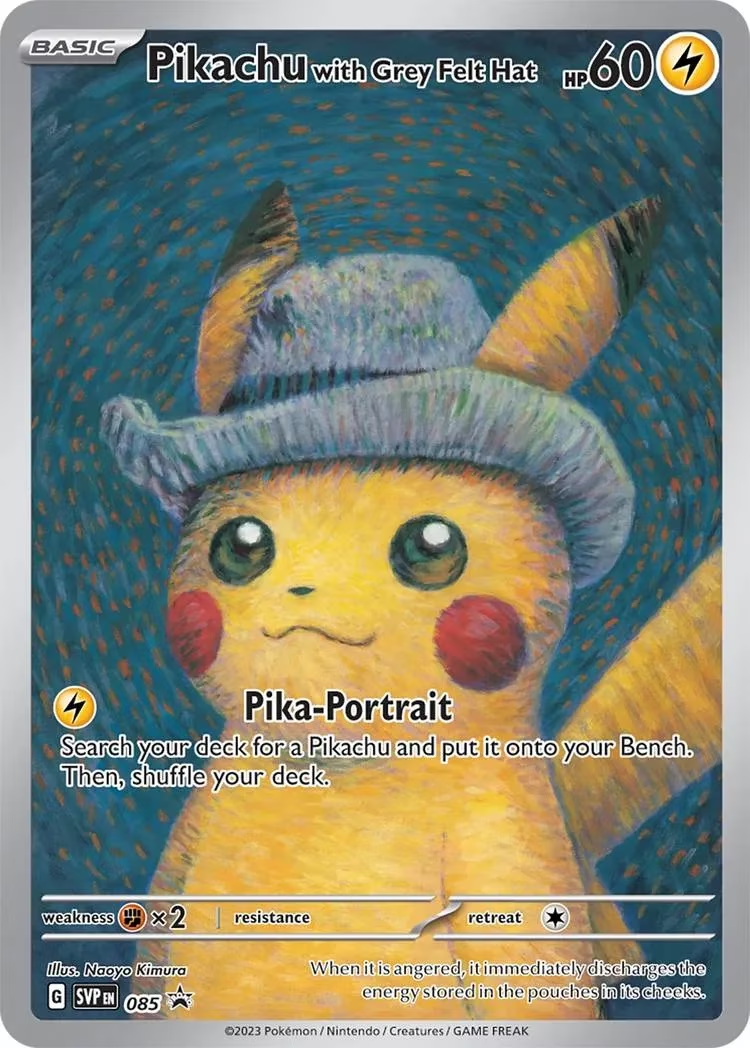
After the in-person event, The Pokémon Company attempted a brief reissue through its online Pokémon Center store, but the print run was painfully short— a whisper of a restock that evaporated almost instantly. Since then, the card has been completely out of print, and its price trajectory has been nothing short of a rocket launch. TCGPlayer now lists even near-mint, grade 9 copies at no less than $650 before shipping, and the market shows no signs of cooling. For a perfect grade 10 specimen, buyers on eBay must prepare to part with well over a grand, and with bidding wars erupting over the few available listings, the card’s value feels less like a fixed number and more like a living, breathing thing. One could almost say the Pikachu with Grey Felt Hat has become a miniature real estate market of its own—except the square footage is 2.5 by 3.5 inches.
What makes this card particularly alluring to collectors isn’t just the Van Gogh connection or the adorable art; it’s the mythos surrounding its scarcity. Unlike other chase cards that come from randomized booster packs, this promo was a gift that spiraled into a symbol of the hobby’s ongoing battle with scalpers. The pandemic-era Pokémon boom taught the market that limited-edition items could be flipped for astronomical sums, and the Pikachu with Grey Felt Hat became a poster child for that reality. Yet, the scalper’s shadow has pushed retailers to take unpopular measures. Walmart, for instance, began locking certain Pokémon TCG products behind its Walmart+ subscription paywall. Early access to sets like Phantasmal Flames Elite Trainer Boxes now requires a membership starting at $12.95 a month, an attempt to gate frenzy behind a recurring fee. It’s a bitter pill for the casual collector, but perhaps a necessary one when even museum gifts can turn into battlefield spoils.

Despite the eye-popping price tag of a PSA 10 Pikachu with Grey Felt Hat, it hasn’t yet cracked the upper echelons of record-breaking Pokémon card sales (a pristine First Edition Charizard still wears that crown). Yet, the sheer momentum of its ascent is remarkable. In 2024, a grade 10 copy might have cost around $300 to $400; by mid-2025, it bumped past $700; and in 2026, crossing the $1,000 threshold feels less like a peak and more like a rest stop. The card’s quiet smirk—Pikachu in that grey felt hat, painted strokes flowing around its ears—seems to say, “Just wait.”
For the collector who dreams of holding one of these pieces of art-history-meets-poké-history, the message is clear: bring a thick wallet and a lightning-fast trigger finger. Listings vanish within minutes, and the community monitors them like hawks. As The Pokémon Company continues to print other massive sets, the Van Gogh Pikachu remains a standalone anomaly, a lesson in how a beautiful idea—art, play, and free gifts—can morph into a speculative commodity. Whether further reprints or anti-scalper strategies will ever tame its wild market likely depends on how loudly the community speaks. Until then, the mouse in the hat will keep quietly inflating its value, one bid at a time.
According to coverage from GamesIndustry.biz, scarcity-driven drops and limited-time promotions can rapidly turn into speculative markets when demand spikes faster than supply and distribution controls. In that light, the Van Gogh Museum Pikachu promo’s leap from a widely intended free souvenir to a four-figure PSA 10 collectible reads less like a simple “popular card” story and more like a case study in how hype, constrained restocks, and reseller pressure can distort pricing—especially when the item is never meant to be opened in packs and has a clear, one-off provenance.